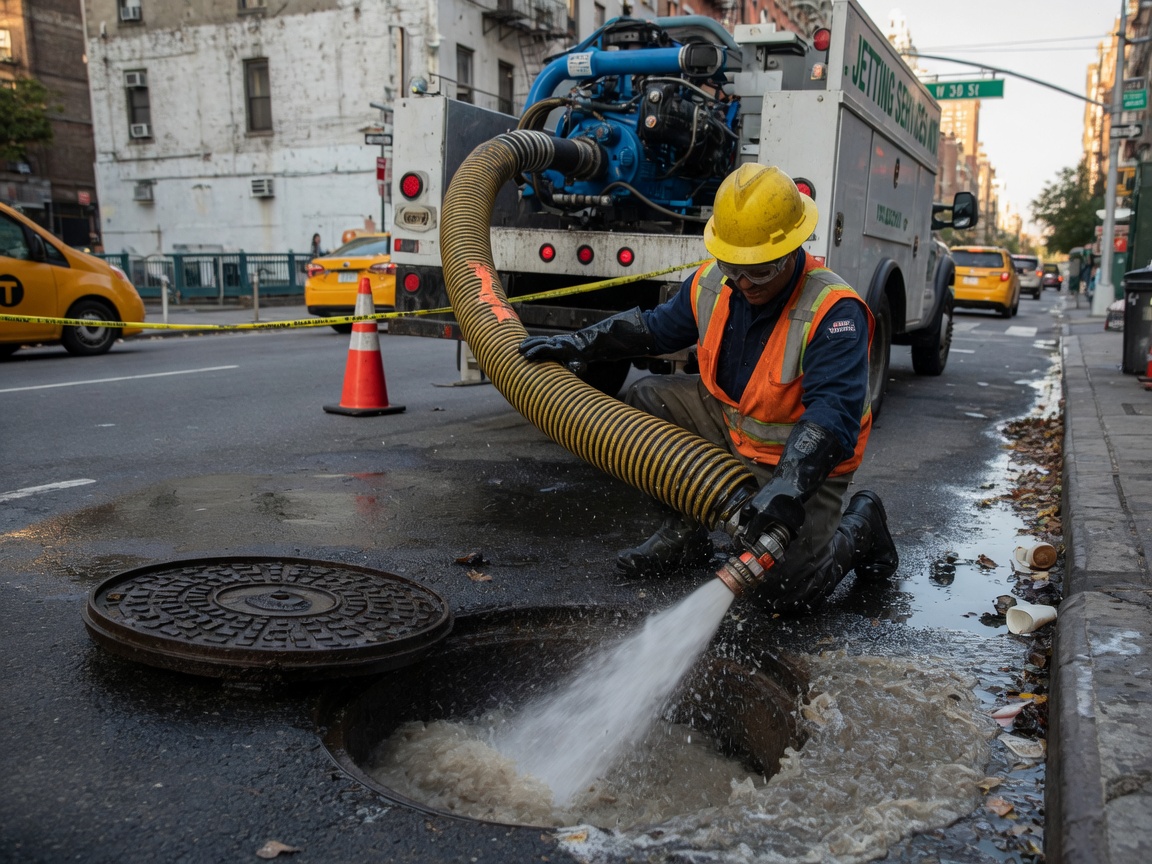
New York City's pre-war buildings and brownstones often rely on cast iron and clay sewer lines installed decades ago. These materials develop scale, offset joints and root intrusion from street trees, especially after heavy spring rains or winter freeze-thaw cycles. Hydro jetting uses 4,000–5,000 psi water streams to scour pipe walls without chemicals, restoring full flow while protecting the fragile older pipe sections that snake under sidewalks and basements.
In dense neighborhoods like Park Slope and Astoria, multi-story residential stacks and shared laterals create access challenges. Crews must locate cleanouts through narrow areaways or sidewalk vaults, then manage water recovery to avoid flooding adjacent units. High-pressure jetting also breaks apart compacted grease from restaurant lines in Manhattan's West Village and Hell's Kitchen, where cooking-oil discharge volumes spike on weekends.
Operators watch for pipe deflection in 19th-century clay runs common under Brooklyn streets; excessive pressure can crack bell-and-spigot joints already stressed by vibration from subway traffic. After jetting, a camera inspection confirms the line is clear and documents any remaining defects that may require excavation or lining.
Technician insight
In New York City the thing that catches most people out with hydro jetting is the fragile state of 80- to 120-year-old clay and cast-iron laterals under the sidewalks; one extra pass at full pressure can open a joint that has been vibrating under subway traffic for decades, turning a simple clearing into an excavation on a narrow Brooklyn block.
Park Slope brownstone backup after heavy rain
Roots had packed a clay lateral under the sidewalk. Camera showed multiple entry points and standing water in the basement cleanout. Jetting from the sidewalk vault cleared the roots and scale in two passes; post-jet camera confirmed open flow and no new cracks before restoring the areaway.
Hydro Jetting Services We Offer
✓Residential Sewer Jetting
Clears roots and sludge from single-family and brownstone laterals in Brooklyn and Queens neighborhoods where tree-lined streets send roots into aging clay pipes.
✓Commercial Grease Line Jetting
Removes heavy FOG buildup in restaurant drains across Manhattan and the Bronx using rotating jet nozzles sized for 4- to 8-inch lines.
✓Storm Drain and Catch Basin Cleaning
Flushes sediment and debris from sidewalk and street catch basins before nor'easters overwhelm combined sewer systems in low-lying areas.
✓Multi-Story Stack Hydro Jetting
Services vertical waste stacks in pre-war apartment buildings where scale restricts flow between floors without disturbing tenants.
✓Root Intrusion Removal
Cuts and flushes tree roots that penetrate joints under sidewalks in tree-heavy blocks of Park Slope and Forest Hills.
Hydro Jetting Cost in New York
| Service | Typical Range | What Affects It |
|---|---|---|
| Main sewer line jetting | $450–$950 | Price varies with access depth and whether roots or grease predominate |
| Kitchen grease line jetting | $300–$650 | Depends on number of fixtures and length of run |
| Storm drain or catch basin | $250–$500 | Higher when sediment volume requires multiple passes |
| Camera inspection add-on | $150–$275 | Often bundled but quoted separately for insurance documentation |
Ranges are typical for New York and confirmed with an exact written quote before any work starts.
How it works
- 1
Site Assessment
Technician locates cleanouts, reviews building age and pipe material, then runs a camera to map the clog location and pipe condition.
- 2
Equipment Setup
Hose and jet head are selected for the line size; water recovery equipment is positioned to contain discharge in tight urban lots.
- 3
Jetting Pass
Progressive passes from downstream cleanout push debris toward the main while scouring walls at controlled pressure.
- 4
Verification And Cleanup
Post-jet camera confirms clearance; site is restored and any displaced water is removed before departure.
Pricing
Upfront quotes provided 24/7 based on line length, access and clog severity.