2026-08-22 · Ray Kopca
How Much Pressure Does Hydro Jetting Use?
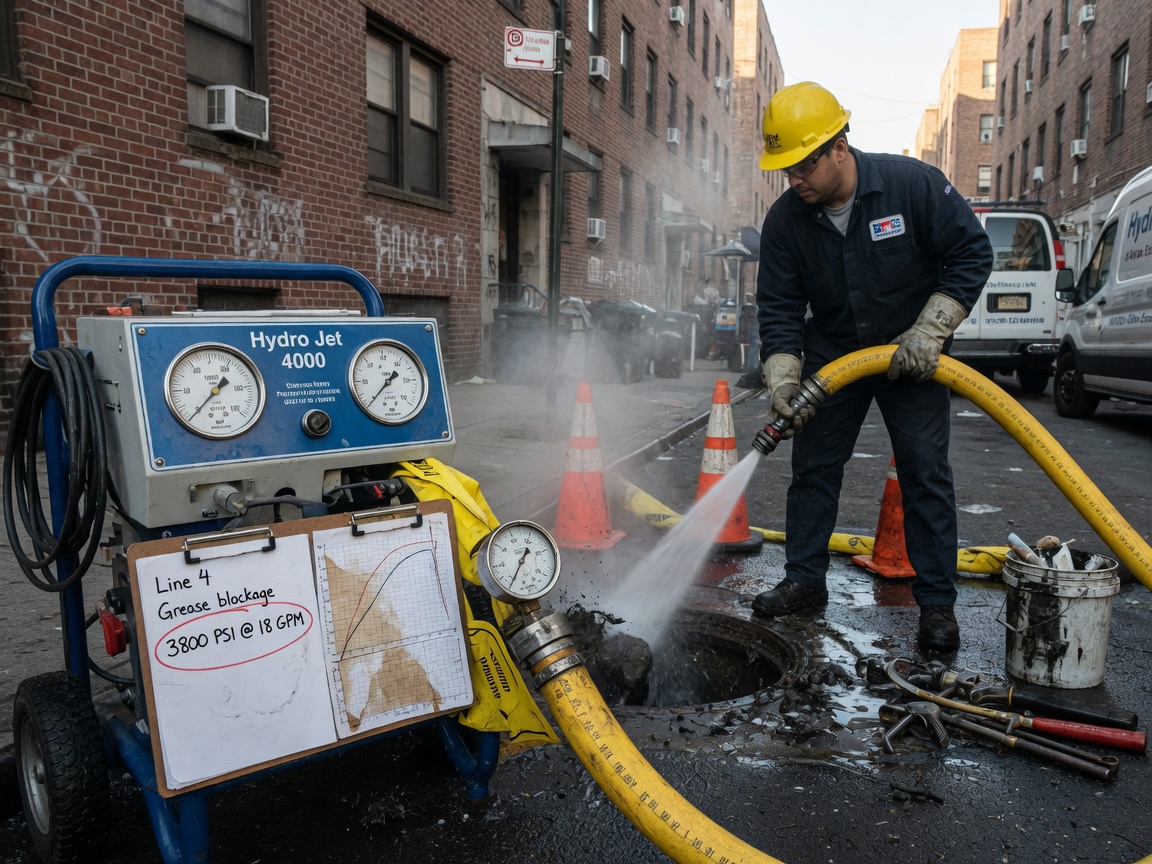
Hydro jetting services in New York City use pressures between 1,500 and 5,000 PSI for most drain and sewer work, with 3,000–4,000 PSI handling the majority of residential and light commercial jobs in neighborhoods from Brooklyn brownstones to Queens row houses.
Pressure Ranges by Pipe Type and Clog Severity
Cast-iron stacks common in pre-1940 Manhattan and Brooklyn buildings often require starting at 2,000 PSI to avoid joint damage while still cutting through decades of scale. Clay laterals under streets in older sections of the Bronx need 2,500–3,500 PSI because root intrusion and mineral buildup create dense blockages that lower pressures simply push aside. PVC lines installed after the 1980s in newer developments tolerate up to 4,000 PSI without risk of cracking when nozzles are kept moving. Stubborn grease traps in restaurant basements around Hell’s Kitchen or the Meatpacking District frequently call for 4,500–5,000 PSI bursts delivered through rotating heads that scour the pipe walls rather than just flushing debris downstream.
How NYC Terrain and Weather Affect Required Pressure
Winter freeze-thaw cycles in northern Queens and Staten Island push soil movement that misaligns joints, so operators raise pressure to 3,200–3,800 PSI to clear the resulting offsets without excavation. Summer thunderstorms dump heavy volumes into combined sewers in low-lying areas of Brooklyn and the Lower East Side, compacting sediment; crews then use 3,500 PSI sustained flow to restore capacity before the next rain event. The high water table near the East River also means lines stay wet year-round, softening grease and allowing lower starting pressures of 1,800 PSI before ramping up once flow is restored.
Nozzle Selection and Flow Rate Combinations
A 1/4-inch hose at 3,000 PSI paired with a 15-degree forward jet nozzle clears most kitchen sink lines in apartment buildings while a 35-degree rotating nozzle at the same pressure scours larger 4-inch main sewer lines under sidewalks. Increasing flow to 8–12 gallons per minute at 4,000 PSI becomes necessary for 6-inch commercial laterals serving multi-family properties in Jackson Heights where grease and wipes combine. Operators monitor pressure at the machine gauge and at the nozzle to compensate for hose friction loss over 150-foot runs common in long Manhattan brownstone basements.
When Higher Pressure Becomes Necessary
Tree-root blockages in older clay pipes under streets in Forest Hills or Ridgewood require 4,200–4,800 PSI with a chain or blade head to cut through without pulling the line apart. Heavy scale inside cast-iron stacks serving pre-war walk-ups in Washington Heights often needs 3,800 PSI plus a descaling nozzle that spins while advancing. In every case the operator begins at the lowest effective pressure and increases only after confirming the pipe material and condition through camera inspection.
Verifying Safe Pressure Application on Site
Before raising pressure above 3,000 PSI on any line, technicians isolate the section and test a short run to watch for leaks at joints or cleanouts. In 24-hour service calls across the five boroughs this step prevents water damage to finished basements common in converted row houses. Continuous monitoring of return flow and pressure drop tells the crew exactly when the line is clear without exceeding the pipe’s structural limit.