2026-08-22 · Ray Kopca
Hydro Jetting Equipment: What Professionals Use
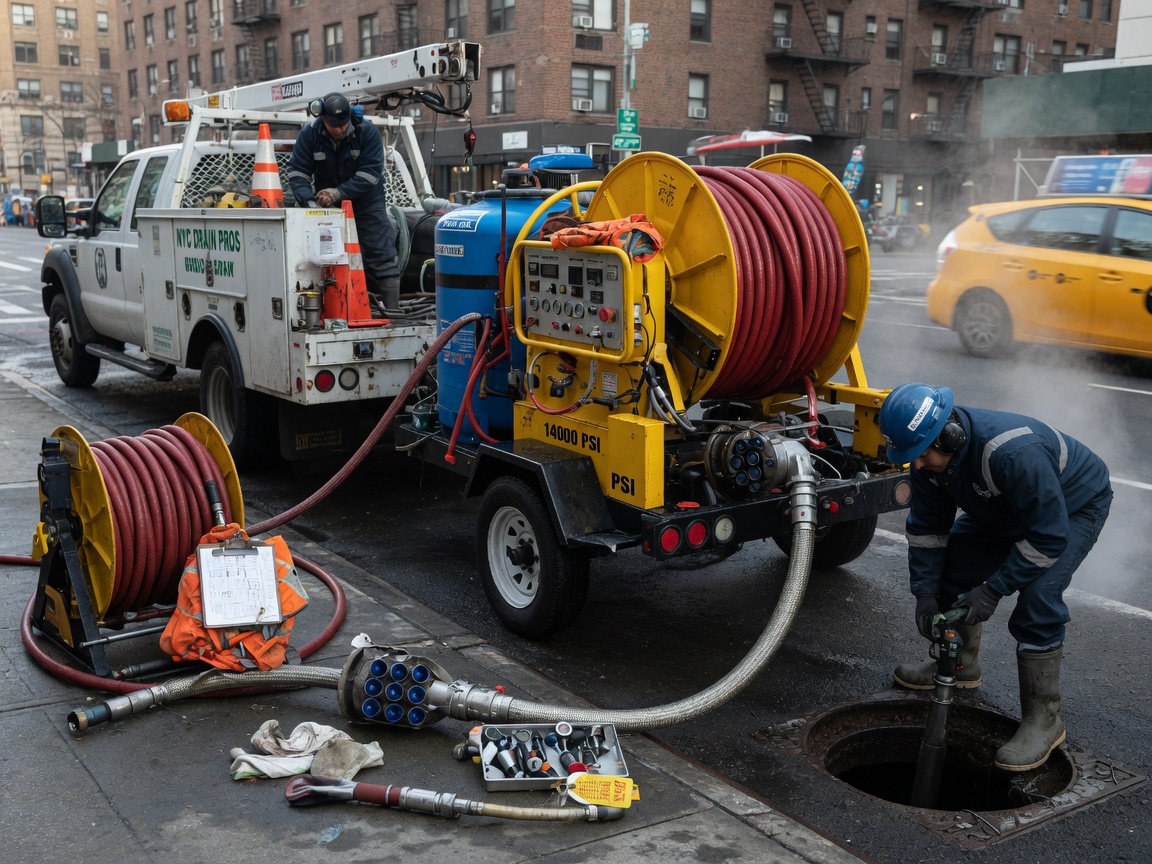
Professionals in New York City use trailer-mounted jetters rated at 3,500–5,000 PSI with 15–25 gallons per minute flow, paired with interchangeable nozzles that match the 4- to 8-inch lines common in pre-war buildings.
High-Pressure Pumps and Power Units
Most crews working Manhattan and Brooklyn brownstones mount 25–35 horsepower diesel engines on 8-foot trailers. These units deliver consistent 4,000 PSI at 18 gallons per minute, enough to cut through the mineral scale that builds inside 80-year-old cast-iron stacks. The engine also powers a 200-gallon onboard water tank so operators can work without tapping hydrants during rush-hour traffic restrictions. In neighborhoods such as Greenpoint and Williamsburg, where basements sit below the street grade, the same pump can switch to a lower 2,500 PSI setting to avoid blowing apart brittle clay laterals that run under sidewalks. Operators check oil pressure and belt tension at the start of every shift because a sudden drop in flow lets grease reattach to pipe walls within minutes.
Nozzles and Jetting Heads
The nozzle selection changes with every job. A 4-inch rotating nozzle with forward jets at 30 degrees clears grease traps in restaurant basements along 9th Avenue. A 6-inch penetrator nozzle with one forward jet and six rear jets at 45 degrees breaks through root masses in the clay lines that serve detached homes in Queens neighborhoods such as Ridgewood. Crews carry at least four nozzle sizes on the truck and swap them at the cleanout rather than forcing one size through every diameter. The rear jets propel the hose 50–70 feet into the line while the forward jet cuts debris; operators count hose markings every 10 feet to know exactly where the nozzle sits relative to the building trap.
Hose and Reel Systems
High-pressure hose on NYC rigs is 3/8-inch or 1/2-inch thermoplastic rated to 5,500 PSI working pressure. Reels hold 300–400 feet so a single setup can reach from a front-yard cleanout to the city sewer main under the street. In older sections of the Bronx where cleanouts sit inside cellars, crews sometimes run the hose through a second-story window and down the stack, adding a 90-degree elbow at the reel to prevent kinking. Daily inspection includes checking for outer jacket cuts that would let water escape at 4,000 PSI and checking the swivel joint for leaks that would reduce downstream pressure. Replacement hoses are kept on the truck because a single nick can shut down a job in the middle of a winter night when temperatures drop below freezing.
Safety and Monitoring Equipment
Every operator wears a face shield, rubber gloves, and steel-toe boots because a nozzle failure can send water at 4,000 PSI in any direction. The truck carries a pressure gauge mounted at the reel so the technician can watch for sudden spikes that indicate a partial blockage ahead. When working near the subway in Lower Manhattan, crews also use a gas monitor because confined basement spaces can accumulate methane from decades of organic buildup. The same monitor alerts the crew if sewer gases rise after the jet clears a long-standing clog. All equipment is stored inside locked compartments so nothing rolls into traffic on narrow side streets such as those in the West Village.
Equipment Choices for Local Pipe Conditions
Cast-iron lines installed before 1950 lose wall thickness at roughly 0.02 inches per decade; a 4,000 PSI jet can strip remaining scale without punching through the pipe when the operator keeps the nozzle moving. In contrast, the vitrified clay pipes under streets in parts of Brooklyn can crack if the jet lingers in one spot. Crews therefore use a slow, steady pull-back speed of about 1 foot per second on clay and increase to 2 feet per second on cast iron. During heavy rain events that raise the water table, operators reduce pressure by 500 PSI to keep displaced soil from collapsing around the line. These adjustments come from years of watching how the same equipment behaves on different pipe materials throughout the five boroughs.